



A Nation in Transition
In 1995, South Africa stood at the beginning of a new chapter. Just a year after the country’s first democratic elections, the Rugby World Cup arrived at a time when unity and nation building were urgent priorities. Rugby, once closely associated with division, suddenly carried the potential to bring people together.
Hosting the tournament gave South Africa an opportunity to present itself to the world in a new light. It also placed the Springboks at the centre of a national story that extended far beyond the field.
Building a Competitive Team
The Springboks entered the tournament without the status of favourites. Years of international isolation had left the team rebuilding, but under captain Francois Pienaar and coach Kitch Christie, a clear identity began to emerge.
The team relied on discipline, structure, and a strong defensive system. Rather than trying to outplay opponents with flair alone, South Africa focused on control and consistency. This approach proved effective as they secured victories over Australia, Romania, and Canada in the pool stages.
Each win strengthened belief within the squad and among supporters, as the possibility of a deep tournament run became increasingly realistic.
The Road to the Final
The knockout stages demanded resilience and composure. In the quarterfinal, South Africa faced Western Samoa in a physically demanding contest that tested their endurance. The Springboks held firm and advanced.
The semifinal against France in Durban presented another challenge, with difficult weather conditions adding to the pressure. Once again, South Africa showed discipline and mental strength to secure a place in the final.
By this point, the team had developed a reputation for determination and tactical awareness, qualities that would be crucial in the final.
A Final for the Ages
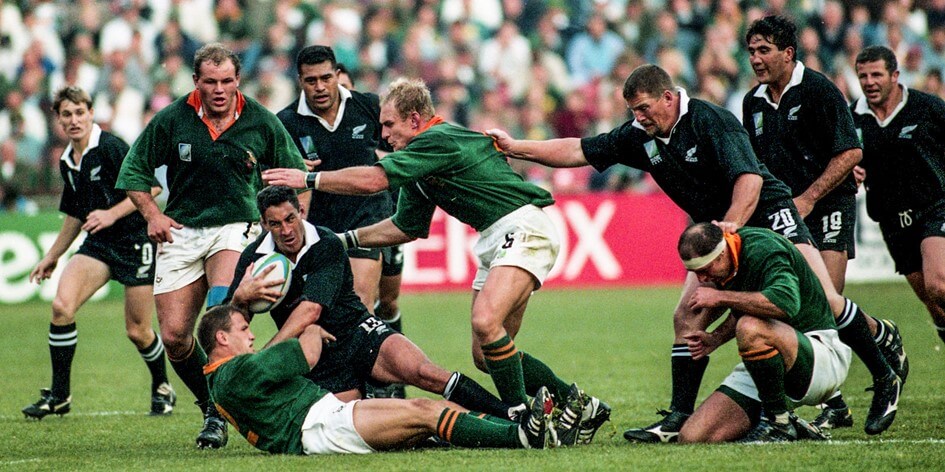
The final at Ellis Park in Johannesburg brought together South Africa and New Zealand. The All Blacks, led by Sean Fitzpatrick and powered by the extraordinary Jonah Lomu, were widely expected to win.
However, the Springboks delivered a defensive performance of remarkable intensity. They managed to contain Lomu and limit New Zealand’s attacking opportunities. The match became a tactical battle, with neither side able to score a try.
As the game moved into extra time with the score level at 12–12, the tension inside the stadium was immense. It was in this moment that fly half Joel Stransky produced a decisive drop goal. His kick gave South Africa a 15–12 lead and ultimately secured the victory.
The Moment That Defined a Nation
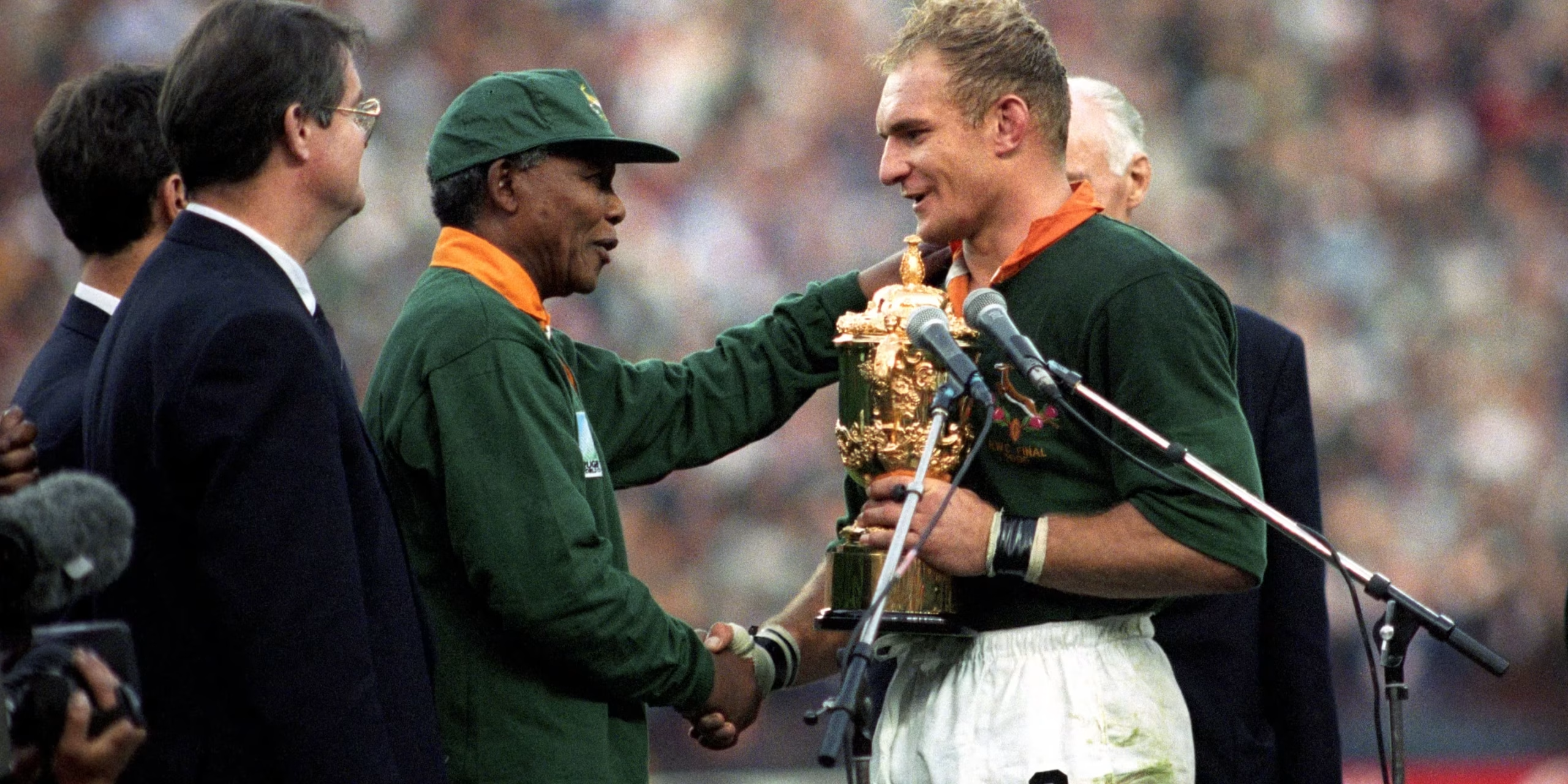
While the match itself was historic, what followed became even more significant. Nelson Mandela walked onto the field wearing a Springbok jersey and presented the trophy to Pienaar.
This moment carried deep symbolism. It represented reconciliation in a country emerging from decades of division. For many South Africans, it marked a turning point where sport helped bridge cultural and racial divides.
A Lasting Legacy
The impact of the 1995 Rugby World Cup continues to be felt decades later. It transformed the image of the Springboks and reinforced rugby’s role as a unifying force in South Africa.
More broadly, the tournament demonstrated how sport can influence society beyond the scoreboard. It showed that moments on the field can carry meaning far greater than the result itself.
The 1995 Rugby World Cup remains one of the most powerful examples of sport’s ability to inspire, unite, and shape a nation’s identity.