



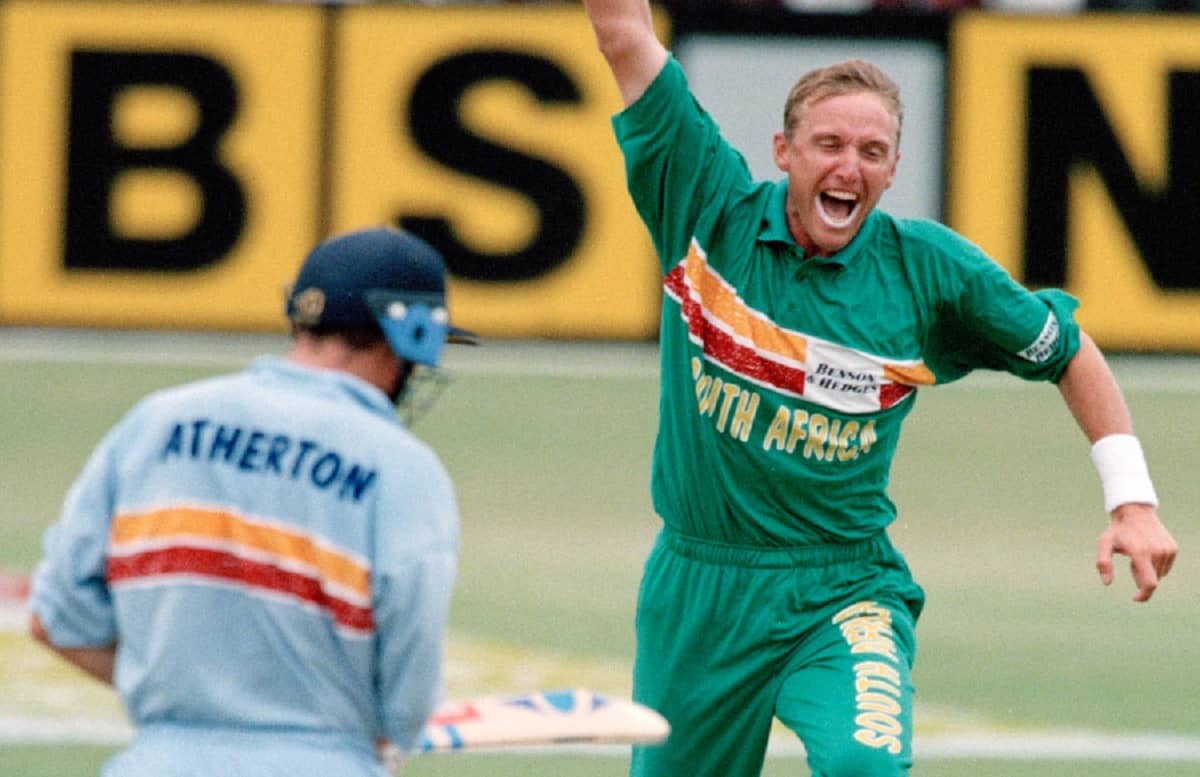
The Rise of White Lightning
Born in Bloemfontein in 1966, Allan Donald developed into a fast bowler with extraordinary natural pace. His performances in domestic cricket quickly caught national attention, particularly for Orange Free State where he consistently troubled batters with bounce and movement.
South Africa’s readmission to international cricket in 1991 created opportunities for a generation of players eager to prove themselves on the world stage. Donald became one of the most important members of that side almost immediately.
His Test debut against India in 1992 announced his arrival, but it was his performances against stronger nations like Australia, England and Pakistan that cemented his reputation. Donald bowled with aggression rarely seen in modern cricket and approached every spell with remarkable intensity.
The nickname “White Lightning” perfectly captured his style. He charged in with explosive energy, bowled at extreme pace and rarely allowed batters any comfort.
A Fearsome Partnership with Shaun Pollock
One of the defining periods of Donald’s career came alongside fellow South African fast bowler Shaun Pollock. Together, they formed one of the most dangerous bowling partnerships in cricket history.
Donald provided raw pace and intimidation while Pollock delivered precision and consistency. Their contrasting styles complemented each other brilliantly and helped South Africa become one of the strongest cricket nations of the late 1990s.
Donald’s ability to reverse swing the ball at high speed made him especially dangerous on worn pitches. He could dismantle batting line ups within a single spell and frequently changed matches through sheer aggression and skill.
His famous duel with Australian captain Michael Atherton during England’s tour of South Africa remains one of cricket’s most memorable rivalries. The contest showcased Donald’s fierce determination and refusal to back down from any challenge.
Numbers That Defined Greatness
Donald retired with 330 Test wickets in just 72 matches and 272 wickets in One Day Internationals. At the time of his retirement, he was South Africa’s leading Test wicket taker.
Statistics alone, however, do not fully explain Donald’s greatness. He played in an era filled with elite fast bowlers including Wasim Akram, Curtly Ambrose and Glenn McGrath, yet remained firmly among the very best.
What separated Donald was his ability to combine speed with discipline. He was not simply fast. He was controlled, intelligent and tactically sharp.
His performances in major series often carried South Africa through difficult moments. Whether bowling on flat subcontinent pitches or fast Australian surfaces, Donald consistently delivered.

The 1999 World Cup Heartbreak
No discussion about Donald’s career is complete without mentioning the dramatic semi final of the 1999 Cricket World Cup against Australia. The match ended in one of cricket’s most heartbreaking moments for South Africa.
Donald was run out in chaotic circumstances during the final over, resulting in a tied match that sent Australia to the final due to superior tournament results. The image of Donald stranded mid pitch became one of the defining moments in cricket history.
Although painful, the moment never erased his greatness. Instead, it highlighted the emotional weight carried by elite athletes competing under immense pressure.
A Lasting Legacy
Following retirement, Donald moved into coaching and mentoring, sharing his expertise with bowlers around the world. His influence continued through coaching roles with South Africa, New Zealand and other international teams.
In 2019, he was inducted into the ICC Cricket Hall of Fame, recognition of a career that transformed South African cricket.
Donald remains one of the country’s most respected sporting figures. His pace, aggression and determination inspired generations of young fast bowlers and helped establish South Africa as a global cricket powerhouse.
For many cricket supporters, Allan Donald was more than just a fast bowler. He was the embodiment of fearless cricket.