



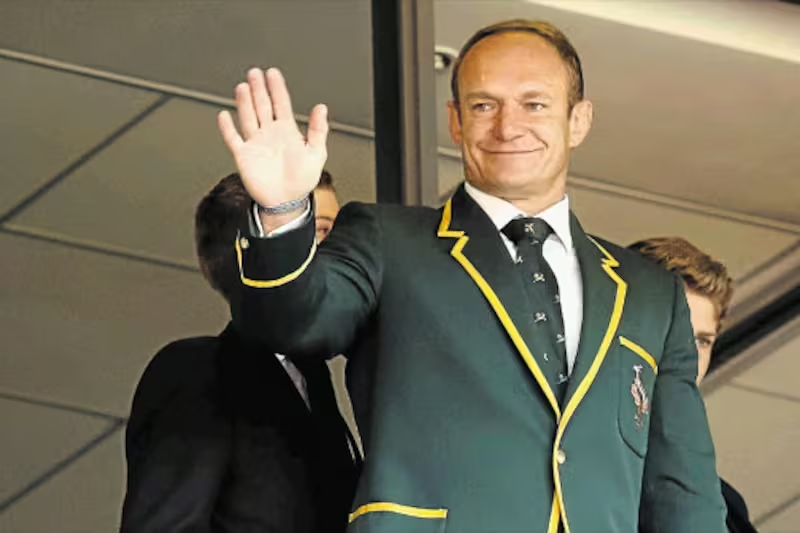
From the Free State to the Springboks
Francois Pienaar was born on 2 January 1967 in Vereeniging, Gauteng, and grew up in the Free State where rugby formed a major part of his upbringing. Like many South African rugby players of his era, Pienaar developed his game through a strong school rugby culture before making his mark at provincial level with Transvaal.
A hard working flank forward known for his intelligence and physicality, Pienaar quickly earned a reputation as a player who led through discipline and determination rather than flair. His performances for Transvaal eventually opened the door to the national side at a crucial time for South African rugby.
The early 1990s marked the return of South Africa to international sport following years of isolation during apartheid. Rugby in the country was undergoing enormous political and cultural change, and Pienaar emerged as one of the key figures trusted to lead the Springboks into a new era.
The 1995 Rugby World Cup and a Defining Moment
The moment that immortalised Pienaar came during the 1995 Rugby World Cup. South Africa hosted the tournament only a year after the country’s first democratic elections, with the nation still deeply divided after decades of apartheid.
At the time, rugby was largely viewed as a sport associated with white South Africans, while many black South Africans supported football instead. The tournament therefore carried enormous symbolic weight. Under Pienaar’s leadership, the Springboks exceeded expectations and reached the final against New Zealand at Ellis Park in Johannesburg.
Before the final, then President Nelson Mandela famously walked onto the field wearing a Springbok jersey with Pienaar’s number six on the back. It became one of the most iconic images in sporting history.
South Africa defeated New Zealand 15 12 after extra time in a tense final, with Joel Stransky kicking the winning drop goal. When Mandela handed the Webb Ellis Cup to Pienaar after the match, the image came to symbolise hope and reconciliation for millions of South Africans.
Pienaar later reflected that the victory was about far more than rugby. His famous words after the final captured the mood of the country when he said the team had not only played for 60 000 fans in the stadium but for 43 million South Africans.
Leadership Beyond Rugby
Pienaar’s influence extended beyond the rugby field. His calm leadership style and willingness to embrace South Africa’s transformation made him one of the most respected sporting figures of the democratic era.
Following the World Cup triumph, Pienaar continued his rugby career in both South Africa and the United Kingdom. He later played for Saracens in England and became involved in business and sports administration after retiring from professional rugby.
His story gained even greater international recognition through the 2009 film Invictus directed by Clint Eastwood. In the film, actor Matt Damon portrayed Pienaar opposite Morgan Freeman as Nelson Mandela. The movie introduced a global audience to the significance of the 1995 Rugby World Cup and the relationship between Mandela and Pienaar.
A Lasting South African Legacy
More than three decades after lifting the Rugby World Cup trophy, Francois Pienaar remains one of the most influential figures in South African sporting history. While his rugby achievements were significant, his greatest contribution may have been helping demonstrate how sport could bridge social and political divides during one of the country’s most fragile moments.
His legacy continues to represent leadership, resilience and the possibility of unity through sport. In South Africa, the image of Mandela and Pienaar standing together at Ellis Park remains a reminder of how rugby became part of the country’s journey toward healing and nation building.