



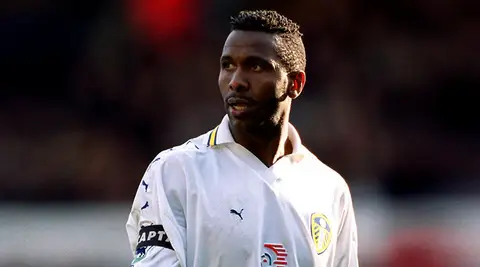
From Soweto Streets to National Hero
The story of Lucas Radebe begins in Diepkloof, Soweto, where football was more than a game. It was an escape, a language, and a pathway to possibility. Growing up in a community shaped by hardship and resilience, Radebe developed a toughness that would later define his playing style. His early football journey took shape at amateur level before he was spotted and signed by Kaizer Chiefs, one of the biggest clubs in South Africa.
At Kaizer Chiefs, Radebe’s versatility stood out. He began as a midfielder but gradually transitioned into defence, where his reading of the game, composure, and physical presence made him exceptional. It did not take long before he became a key figure at the club, earning admiration for his consistency and discipline.
The Leeds United Legacy
In 1994, Radebe made a bold move to England, joining Leeds United alongside fellow South African Phil Masinga. The transition was not easy. English football in the mid-1990s was physically demanding and culturally different, but Radebe adapted with remarkable determination.
Over time, he established himself as one of the most reliable defenders in the Premier League. His leadership qualities became increasingly evident, and he was eventually named captain of Leeds United. At Elland Road, he earned legendary status, not just for his performances but for his loyalty. Despite interest from bigger clubs, including reported admiration from top European sides, Radebe chose to stay with Leeds, cementing a bond with supporters that remains strong to this day.
His reading of the game, calmness under pressure, and ability to organise the defence made him the backbone of the team. He led Leeds during one of their most competitive eras, including memorable European campaigns, and became a symbol of integrity in a rapidly changing football landscape.
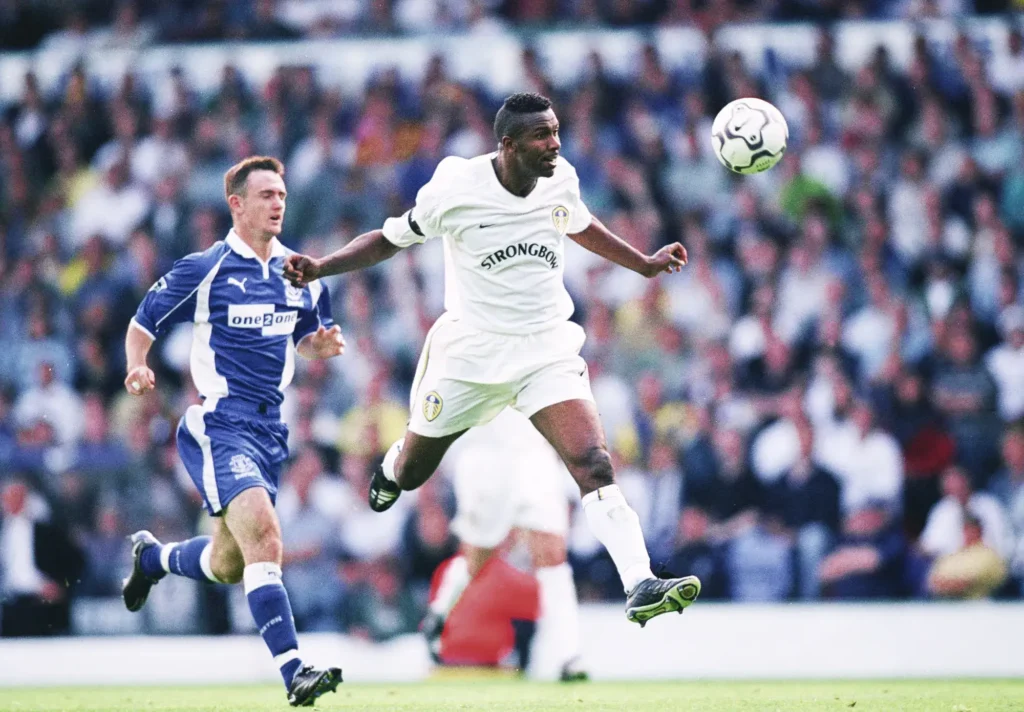
Captain of a New Football Nation
Radebe’s influence extended far beyond club football. As captain of South Africa national football team, he played a crucial role during a defining period in the country’s sporting history. South Africa had only recently returned to international football following the end of apartheid, and the national team carried immense symbolic weight.
Radebe was at the heart of this new era. He captained Bafana Bafana during the triumphant 1996 African Cup of Nations, where South Africa lifted the trophy on home soil. That victory remains one of the greatest moments in the nation’s football history.
He also led the team at the 1998 FIFA World Cup and the 2002 FIFA World Cup, representing his country on the global stage with dignity and pride. His leadership style was never loud or flamboyant. Instead, it was rooted in consistency, humility, and example.
Leadership Beyond the Pitch
What sets Radebe apart is not only what he achieved on the field but how he carried himself off it. He became a respected ambassador for South African football, using his platform to promote social causes and community development. His work with organisations such as Laureus Sport for Good reflects a deep commitment to using sport as a tool for positive change.
Radebe has also remained closely connected to Leeds United, where he continues to be celebrated as one of the club’s greatest captains. His legacy at Elland Road is so profound that he is often mentioned in the same breath as the club’s all-time greats.
A Legacy of Loyalty and Respect
In an era where football careers are often defined by transfers and trophies, Lucas Radebe’s legacy stands out for different reasons. It is a legacy built on loyalty, leadership, and quiet excellence. He was not just a defender who stopped goals. He was a leader who inspired belief.
For South African football, he represents a golden generation that reintroduced the country to the world. For Leeds United, he remains a symbol of commitment and class. And for many young players, his journey from Soweto to global recognition serves as a powerful reminder of what is possible.
Lucas Radebe did not need to shout to be heard. His game, his leadership, and his character spoke loudly enough.