



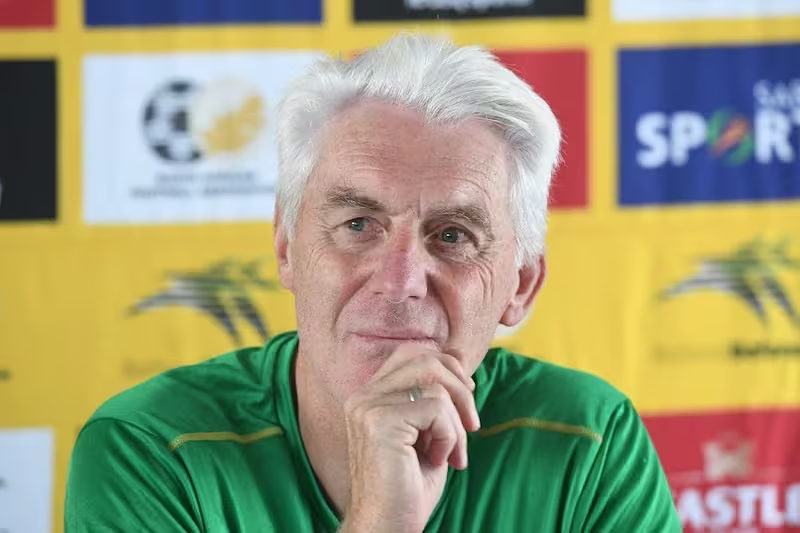
Belgian football manager and former international player
Early life and introduction to football
Hugo Henri Broos was born on 10 April 1952 in Humbeek, a small town in Belgium. Like many Belgian footballers of his generation, his journey into the professional game began at local level, playing for his hometown club KFC Humbeek. It was there that his defensive discipline, composure, and natural reading of the game began to stand out.
At just eighteen years old, Broos’ potential was spotted by a scout from Belgian giants RSC Anderlecht. The move marked the beginning of a career that would see him grow into one of Belgium’s most respected defenders and later an accomplished manager with success both in Europe and Africa.
Playing career
Rise with Anderlecht
Broos spent more than a decade at Anderlecht and became a cornerstone of the club’s defence during one of the most successful periods in its history. Playing primarily as a central defender, he developed a reputation for tactical intelligence, reliability, and leadership at the back rather than flashy play.
During his time in Brussels, Anderlecht established itself as both a domestic powerhouse and a respected European competitor. Broos helped the club capture three European trophies, three Belgian league championships, and four Belgian Cups. These achievements placed him among the most decorated defenders of his era in Belgian football.
His performances at club level earned him recognition at international level as well. Between 1974 and 1986, Broos represented the Belgian national team, collecting 24 caps. He was part of the squad that achieved a memorable fourth-place finish at the 1986 FIFA World Cup in Mexico, one of the strongest showings in Belgium’s football history at the time.
Move to Club Brugge
In 1983, Broos made a significant career move when he joined Club Brugge, another Belgian heavyweight. The switch continued his success story, as he remained a key defensive figure for five seasons.
With Brugge, he added further honours to his collection, winning the Belgian Cup in 1986 and the league championship in 1988. By the time he retired at the end of the 1987–88 season, Broos had built a reputation as a serial winner. Across his entire playing career, he lifted the Belgian Cup five times — a testament to both consistency and longevity at the highest level.
His playing days were defined less by glamour and more by steadiness and tactical assurance, qualities that would later shape his coaching philosophy.
Transition into coaching
After hanging up his boots, Broos did not drift far from football. Instead, he quickly moved into coaching, where he would prove to be just as effective from the touchline as he had been on the pitch.
His managerial career officially began in the early 1990s, and it did not take long for him to establish himself as one of Belgium’s most competent and respected coaches.
Club Brugge success
Broos returned to Club Brugge in 1991, this time as head coach. Over the next seven years, he guided the team through one of its most productive modern eras.
Under his leadership, Brugge won two Belgian league titles in 1992 and 1996, along with three Belgian Cups in 1991, 1995 and 1996. His teams were known for their organisation, discipline, and balance between defence and attack — principles that reflected his own playing style.
His work at Brugge earned him widespread acclaim and two Belgian Coach of the Year awards, confirming his standing among the country’s elite tacticians.
Anderlecht and Genk spells
In 2002, Broos took charge of Anderlecht, the club where he had built his reputation as a player. The return proved fruitful initially, as he guided the side back into the UEFA Champions League and won the Belgian league title in the 2003–04 season.
However, the following campaign brought challenges. Early exits in European competition and the domestic cup increased pressure, and after a goalless draw against Gent, Broos was dismissed — the first sacking of his coaching career.
Later that same year, he joined KRC Genk. There, he rebuilt his reputation, notably defeating his former club Anderlecht 4–1 in a symbolic victory. His work with Genk earned him another Coach of the Year award in 2007, further underlining his adaptability and resilience.
Experience abroad
After years of success in Belgium, Broos broadened his horizons and began coaching outside his homeland. In 2008, he joined Greek club Panserraikos, marking his first foreign assignment. The team enjoyed a strong Greek Cup run, eliminating Panathinaikos before eventually losing to AEK Athens in the semi-finals. Despite the cup success, relegation in the league proved unavoidable.
He later had brief spells with Trabzonspor in Turkey, Zulte Waregem, and worked as an assistant at Al Jazira Club. These years were more transitional but added valuable international experience to his résumé.
Cameroon national team
Broos’ most prominent achievement as an international coach came in Africa. In 2012, he became manager of the Cameroon national team. Expectations were high, and he gradually rebuilt a squad that had lost some of its former dominance.
His crowning moment arrived at the 2017 Africa Cup of Nations. Cameroon defied expectations to win the tournament, defeating Egypt in the final. The triumph was widely regarded as one of the competition’s great underdog stories and cemented Broos’ status as a coach capable of inspiring collective belief.
After leaving Cameroon in 2018, he briefly served as sporting director at K.V. Oostende.
South Africa national team
In May 2021, Broos was appointed manager of the South Africa national team. His task was to restore competitiveness and consistency to a side searching for stability.
Progress followed steadily. At the 2023 Africa Cup of Nations, South Africa finished third, a strong performance that re-established the team among the continent’s contenders. His structured, pragmatic approach brought defensive solidity and renewed confidence.
In October 2025, Broos led South Africa through a successful qualifying campaign for the 2026 FIFA World Cup, another major milestone in his long career. Shortly afterwards, he announced that he would retire from coaching following the tournament, bringing an end to more than three decades on the sidelines.
Legacy and style
Hugo Broos’ career has been defined by durability, discipline, and quiet authority. As a player, he was dependable and tactically sharp. As a coach, he favoured organised systems, defensive stability, and collective teamwork over individual stardom.
Few figures in Belgian football have enjoyed sustained success both as a player and a manager. Add continental triumph with Cameroon and meaningful progress with South Africa, and Broos’ influence clearly stretches beyond Europe.
From Humbeek’s local pitches to international tournaments, his journey reflects a lifetime devoted to the game — one built not on hype, but on consistency, leadership, and results.