



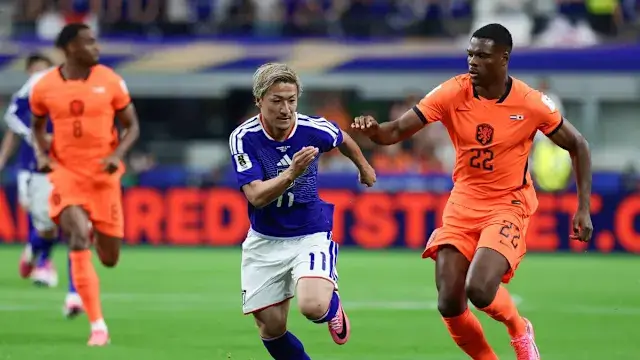
There are football matches that you watch for the result. And then there are football matches that you watch because something about them just refuses to let you look away, where the drama builds layer on layer and by the final whistle you are exhausted and elated and cannot quite believe what you just witnessed.
Netherlands versus Japan at the 2026 FIFA World Cup was that second kind of football match. Completely, absolutely, unreservedly.
Final score: Netherlands 2, Japan 2. Japan came from behind. Twice. Against the Netherlands. At a World Cup.
The Setup
The Netherlands are one of the great footballing nations. Three World Cup finals (1974, 1978, 2010). Countless iconic players. A football philosophy so deeply embedded in their national identity that even their youth teams play in a recognisably Dutch way. Coming into this tournament, they were considered a dark horse, capable of going very deep if their squad clicked into gear.
Japan, meanwhile, have built one of the quiet revolutions in modern international football. A generation of players developed in the J-League and then exported to Europe, where they have excelled at clubs across the Bundesliga, the Premier League, and beyond, has produced a national team of technical quality, athletic intensity, and tactical intelligence that consistently punches above its weight at the highest level.
Japan beat Germany at the 2022 World Cup. They beat Spain. Twice, in that tournament, they came from behind against a European giant and won. The template existed. And against the Netherlands in 2026, they executed it again.
How the Match Unfolded
The Netherlands took the lead. Dominant in the first half, winning the physical battle in midfield and creating through the wide channels, the Dutch had the quality to turn pressure into goals. The opener came from a move of real quality, the kind of goal that looked inevitable once the Netherlands had established their early control.
Japan absorbed. Japan pressed at the right moments. And then, with a counter-attack of the kind that has become the hallmark of this generation of Japanese players, they equalised. The Japan goal was a thing of beauty, quick, precise, devastating. Netherlands 1, Japan 1.
The Netherlands scored again. Because of course they did. Conceding an equaliser sharpens concentration, and the Dutch had enough quality across the pitch to find a way back ahead. The game seemed to be trending toward a Dutch victory.
And then Japan equalised again.
The second Japanese goal was the moment the stadium, and everyone watching around the world, fully surrendered to the drama. By the time the final whistle blew, even the Dutch supporters could barely be angry about the result. What they had just watched was simply too good.
Japan’s Blueprint Is Now Official
Qatar 2022 was not a fluke. That needs to be said clearly, because at the time some observers were inclined to dismiss Japan’s giant-killings in that tournament as the product of specific circumstances. A particular tactical setup from Germany. A vulnerable Spain. It will not happen again, the argument went.
It happened again.
Japan’s ability to defend compactly, suffocate attacks, and then transition with explosive pace and precision against teams that have committed their full-backs forward is now a documented, reproducible blueprint. At 2022, it was a surprise. At 2026, against the Netherlands, it was a statement.
This Japan team contains some genuinely world-class individual players. Their attackers combine the direct running qualities that European football has developed in them with the technical foundation of Japanese football culture. The result is a team that is simultaneously hard to play against and thrilling to watch in transition.
How far they go in this tournament remains to be seen. But no opponent in the knockout rounds should look at Japan’s draw with the Netherlands and see a team they can take lightly.
What This Means for Both Teams
Netherlands and Japan both have work to do in their remaining group games. A draw in this fixture, while enormously entertaining for the neutral, means that qualification is not yet secured for either side.
The Netherlands will need to regroup and find the defensive solidity that a draw against Japan exposed as insufficient. But their attacking quality is not in doubt. They will score goals in the games ahead.
Japan need to back up this performance with consistent results. If they can carry the same intensity and counter-attacking threat into their remaining group fixtures, they are entirely capable of reaching the knockout rounds for the third consecutive World Cup.
The Match of the Tournament
In a World Cup that has already produced Messi’s hat-trick, Cape Verde’s shock, Canada’s six-goal destruction of Qatar, and Sweden’s five-goal romp against Tunisia, it says something about Netherlands versus Japan that it still stands clearly as the match of the tournament so far.
Not because of the goals, exactly. But because of the narrative. The back-and-forth. The refusal of either side to accept that the game was over. The second Japan equaliser landing like a wave that washed away everything that came before it.
Football produces moments like this rarely enough that when they happen, you stop and say: I am glad I watched that. I am glad that existed.
Netherlands versus Japan, 2026 World Cup. Glad it existed.
FAQ: Netherlands vs Japan World Cup 2026
What was the score between Netherlands and Japan at the 2026 World Cup?
The match ended 2-2, with Japan twice coming from behind to equalise against the Netherlands in one of the tournament’s most dramatic group stage fixtures.
How many times did Japan come from behind?
Japan came from behind twice in the match, equalising after the Netherlands took a 1-0 lead and again after the Dutch went 2-1 up.
Is this Japan’s first World Cup appearance?
No. Japan are regular World Cup participants and appeared at the 2022 World Cup in Qatar, where they famously beat Germany and Spain in the group stage.
What group are Netherlands and Japan in at the 2026 World Cup?
Both Netherlands and Japan are in the same group at the 2026 FIFA World Cup.
What was considered the best match of the 2026 World Cup after the first round?
Netherlands 2-2 Japan is widely regarded as the best match of the 2026 FIFA World Cup group stage after the first round of fixtures.
Internal Links:
- World Cup 2026 Golden Boot Race
- 88 Goals in 27 Games: The World Cup Goalfest
- World Cup 2026 Biggest Storylines
- FIFA World Cup 2026 Hub
- Bafana Bafana World Cup Updates
External Links: